Friday, September 26, 2008

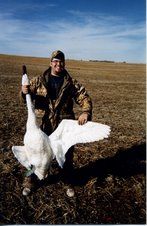
MN Early Goose Opener


Labor Day, with most of my peers taking jet-ski rides around the lakes or at the MN State Fair, Matt Gouette and I were in south central Minnesota scouting for geese. We choose to scout and hunt a new area for a couple different reasons. One, the new area is about half the distance of our old haunts in western Minnesota and two I heard from my friend J.D. Westerholm there was a good amount of geese down there.
The stock market guru Warren Buffet says that it is impossible to tell what will happen to the market in the short run, and very easy to tell what will happen in the long run. That is how I feel about goose hunting in Minnesota. The night before the early goose opener in Minnesota, even with a lot of time put in scouting, I am still not sure what to expect the next morning.
Matt Gouette and I had found a lot of geese in the area we were going to hunt, but we could not get permission for the two cut cornfields the geese were using. Through talking with the landowner we did know that the fields were going to be hunted on opening day. So our plan was to set up in a field in the flight path between the roost and the two fields the geese were using. With the commotion of opening day we figured we could coax a few young Canada geese into our decoys.
As a backup, there was a small pond and a larger body of water we could hunt. Both of which were with in a half-mile of the roost the majority of the birds were using. Once again, due to the confusion of opening day we were confident that with decoys and calling we could bring birds into range in either of these spots.
So as we drove to the field on the morning of Sept 6th, the outcome was going to be anyone’s guess. Were other hunters going to blow the roost? Was there going to be pass shooters in the area? Wind, no wind, rain? In the long-term I knew that if I put my time in I was going to have some good days hunting Canada geese in Minnesota. As for the short-term we were about to find out.
When Matt and I got to the field we were going to hunt there was little sign of other hunters in the area. As we set up the decoys and brushed the blinds we only saw a few vehicles drive by. Most of which were cars so I assumed that they were not hunters. It was getting lighter out and I kept thinking to myself, ‘this could be good.’
Once the hands of the clock indicated that it was legal shooting time the geese were more easy go than easy come. Goose calls being played by hunters began to sound all around us as if they were to start on queue.
Still I thought that we had an okay chance of getting a few geese but once the shooting started I wasn’t sure. All the flocks we saw coming off the roost flew higher and higher as the sun rose. All of which wanted nothing to do with our decoy spread. We even saw one flock circle a decoy spread that was not far from us like ten times. Then once the group shot, not a single bird fell. Which tells me that they were possibly out of range. Still the birds were acting more like late season birds.
Matt and I were packing up the spread when a DNR officer drove up and checked our licenses and shells. He said that a few pass shooters had geese and the hunters in the cut sweet corn fields had harvested a few geese. The officer also confirmed my assumption that hunters had set decoys on the water the geese were using as a roost. They too had shot a few geese.
My first Minnesota goose opener in nine years was a good reality check for Matt and I. It did solidify my belief that goose hunting on opening day is a roll of the dice, and that still it is better to be out and about than sitting on the couch. All was not for not, we were able to switch areas for the Sunday morning shoot and set up on a water hole with no scouting hoping to ‘run traffic.’ We shot one goose Sunday morning, the only bird that came into the decoys or with in range the whole weekend for that matter. When the bird came in, it came in hard, cupped and committed.

Monday, August 18, 2008

DRC


To be honest, it there was a jury full of ducks and geese; I would probably be on death row. The last couple of years I have been lucky enough to hunt waterfowl in several states and Canada each season. In doing so I have hunted with lots of different people using lots of different techniques. Coming home and hunting around my home state of Minnesota using new techniques is challenging and exciting.
I believe that Minnesota waterfowl hunters have more all-around knowledge and hunt harder then hunters from many other states. Minnesota waterfowl hunters must be continually learning and trying new things to be successful. This innovation results in many leading edge products being born in Minnesota.
The short-reed goose call may not have been born in Minnesota, but it certainly has evolved here. Not only is Minnesota home to some of the country’s best goose callers, there are many call-makers that file their taxes within in our great state. The newest call company, Death Row Calls, is quickly making a name for it’s self in the field and on stage.
I imagine that it was a sunny day at the Gamefair when a blonde-haired, younger guy from Thief River Falls stunned a quite audience by winning the 2007 State Goose Calling Championship. I have to imagine because I was not there, but when I heard the news through the grapevine I was excited.
That guy’s name is Cory Loeffler, and for those that know him it should have come as no surprise that he would be crowned state champ. I have known since Cory through calling contests since the fall of 2004. Cory has been collecting plaques and beating this author in calling contests up and down the Red River valley since then.
The thing that surprised me was that Cory won the state championship that day with a call from his new call line, Death Row Calls or DRC for short. Cory had started the new call line in the early part of 2007 and I was impressed by the calls when I first got to try one the second weekend of the ’07 Gamefair.
Not only were the DRC calls displayed on stage during the Gamefair, Cory, being a smart entrepreneur, had a booth at the popular event. When I had the opportunity to congratulate Cory in person, the DRC table was littered with plaques collected by the DRC crew that week. Around the DRC shop in Thief River the guys like to joke that the Death Row Calls line should have gotten an award for being the ‘rookie of the year.’
In it’s first year of existence the Death Row Calls line has won nearly 30 calling competitions. Besides the Minnesota State goose, callers won the North Star Two Man duck and goose with DRC calls. The North Star is a major calling competition held annually in Minnesota, usually at the Gamefair. Competition callers come from all over the country to compete in this event.
I am the kind of waterfowl hunter who likes to wear my passion for the sport all year. At any time you can catch me wearing apparel from various outdoor product manufactures. Another thing Cory has done right is design and print shirts and sweatshirts that are stylish. Believe it or not, goose calling is becoming a Fad with the younger generations.
I would like to end this column with a quick story. Contrary to popular belief, many of us who travel and compete in various calling contests across Minnesota get along very well. I met Cory Loeffler backstage at a calling contest. Although he is mainly a goose caller, once we were both waiting behind the scenes for a duck calling competition. I was surprised when he told me then that it was going to be the first time he had competed at duck calling. We joked around a little and I ended up finishing in second place. Cory says that if you don’t know how to call, you shouldn’t make calls. That day he took first in his first duck calling competition.
If you want to learn more about Death Row Calls feel free to call Cory at the DRC shop 218-686-6617. Or check out www.deathrowcalls.com.

Suspended Crappies


It’s all down hill from here. Not really but soon the summer sun will heat the waters of Minnesota lakes and the fish will go deep. Walleyes, found in shallow water until mid-June will be tough to find, and big schools of largemouth bass will move in search of cooler water. This is when I switch my focus to panfish.
For the next couple of week’s crappies will be my fish of choice. In Minnesota crappies can be fished for and caught all year round. I find that fishing for them post-spawn is more of a challenge. Early in the spring one can simply tiptoe down my dock and my neighbors and catch a few crappies straight jigging with a minnow. I wait till these fish go deep to pursue them.
Traditionally, crappies with their “paper mouths” are a challenge to catch and these fish make excellent table fair. They are pleasure to land and consume.
While fishing the other day I noticed a school of crappies swarming the surface of the calm water on the lake I was fishing. I should have switched tactics and presented theses fish with a jig. However, I am hardheaded and I wanted to fool one more walleye while the fish were still hanging in shallower water.
Some people fish for Crappies using a minnow and a plain hook. Personally, I use jigs or jig heads tipped with minnows. I have found that a 1/16-ounce jig tipped with a fathead minnow works the best. The largest jig size I would use for Crappie is 1/8-ounce. As a rule, I usually say the smaller the better, this allows for a slower presentation. Some fishermen swear by tube jigs, twister tails and flu flu’s. All these are added attractants, which I find myself using only when I run out of bait.
Crappies are a suspended fish by nature, hanging on the edge of weed lines off the bottom. Crappie strike upward, like the majority of fish. This makes it crucial for fishermen to present their bait or jig above the fish. If you are fishing below them, or at their level, you might as well be sitting at home playing video games.
I have found that Crappie hit slower presentations the most, often times on the drop of the cast. The best way I have found to place the jig at the right depth and speed is using a slip-bobber. If I find a school of Crappie suspended five feet from the surface of the water, I set my slipknot at four feet. With a 1/16-ounce jig head tipped with a minnow, I will cast ten to fifteen yards. Once the slipknot has reached the bobber I slowly reel the set-up in.
Not only does the slip bobber allow the less experienced fishermen to place the jig at the proper depth and speed, it also helps with the hook set. When jigging without the bobber I find the majority of fishermen pull the jig out of the fish’s mouth, or set it after the fish has spit it out. The bobber seems to allow the perfect delay for an accurate hook set. Of course, using the proper equipment helps as well. Ultra light rods and reels are essential to feeling hollow strikes while panfishing.
Mastering the technique is unfortunately easier then finding the fish. It is important to first scout out beaver dams, sunken islands and channel openings when searching for schools of crappie. Look for them to be in roughly ten feet of water suspended five to six feet from the bottom.
In my youth my cousin would always bring along a few Daddy-longlegs spiders when we went out panfishing. When we got to suspected areas he would toss them on the calm water. The spiders would run for shore and we would locate schools of crappies by the fish attacking the spiders on the surface of the water. When fishing, sometimes you have to think outside the box to be successful.

Monday, June 9, 2008

Bass Basics


The first step I took as a fisherman was from catching sunnies off the dock to casting for bass along the docks. It is true that bass are a sunfish, so in theory this is a logical step. Most of my friends, like me, first started serious fishing for bass and then transitioned into walleyes.
Early in the year bass can be found in shallow hard bottom parts of many lakes. These are the spawning beds that the bass use. Bass can be caught in these areas by casting many different types of presentations. I have had the most luck using white or chartreuse spinner baits with fast retrieves. The hard bottoms of these locations are key for finding fish; a good spot to start is sandy bottoms or bulrushes.
Once the water warms up the bass will move into deeper cooler water. Under normal conditions in the mid-west this should occur in early June. Bass can be caught in 6-10 feet of water casting shallow diving crank baits and spinner baits. Small spoons and live bait presentations can work too.
Through July bass will move deeper but can be fished using the same methods. I have had very good luck catching largemouths with leeches while walleye fishing in the dog days. In fact some would argue that live bait presentations might be the best way to catch bass. Longtime guide Marv Koep of the Brainerd Lakes area swears by fishing with redtail chubs in 8-12 feet of water. The largemouth bass after all is in the Panfish family and I do not know of a better way to catch panfish then with a bobber.
Schools of Largemouth Bass and that contain larger fish are most commonly found in deeper water. The exception is that some fish find shade under docks and boats. Bass find these places to be ideal for eating bluegills as well. I have found casting spinner baits in these areas is the best approach. Spinner baits are the most versatile lure on the market; you can fish them deep, shallow, and they don’t usually hook up on weeds and docks. My buddies and I refer to this approach as “bass-mastering it.”
On lakes with softer bottoms lily pads also provide shade on sunny days for largemouth bass. Spots where the lily pads end, and drop offs begin are good locations. During the day try casting weedless spoons and top water lures into the lily pads. The key with top-water is to have a very slow retrieve. If you bring a top-water lure over the drop off make sure to really slow it down once the lure has moved past the weeds. You want to give the bass the impression that the lure ventured into some place it shouldn’t have.
If you don’t have success in the lily pads then go back along the same shoreline and fish the drop off. I like casting crankbaits that dive quickly like the Rapala fat-raps and rattle-traps. Cast the lure on the edge of the lily pads so it cranks down the drop off on the first part of your retrieve. Different colors work in different lakes during different light conditions. A good color to start with when using crankbaits for bass is crawdad.
In northern Minnesota Smallmouth Bass can be caught by casting the same lures along rocky drop offs. These spots can be identified by steep shorelines. This is where the smallies go to feed on crawfish. For lure color my first choice always depicts that.
During mid-day and later in the summer Smallmouth bass can be found around rocky humps. These humps can be found anywhere from 25-15 ft of water depending on the lake and weather. I cast or drift with 1/4 oz jigs tipped with minnows for these fish. By doing this I often catch walleyes too, or vice versa.
Fishing is all about mastering patterns. If you are not having any luck casting in shallows, try switching colors or presentations. If that does not work try different depths and different cover. When in doubt go back to fishing basics and try a bobber and a leech.

Weed Walleyes


The lake that I fish the most is not what you would classify as a “traditional” walleye lake. The lake does not contain any mud flats or rocky points. It is a weedy lake, and the walleyes are weed walleyes. I have found that cabbage flats that are ten to fourteen feet can produce highly productive fishing all year long. Walleyes, largemouth bass and pike all feed in cabbage because certain types of minnows take refuge within them. When fishing for walleyes on these weedy lakes, a good place to start is a cabbage flat on your lake you consistently catch pike on. A wise fisherman once taught me that wherever there are pike, walleyes are just a step behind.
The DNR often stocks walleyes on these weedy lakes to help grow their populations. These weedy lakes do not contain the rocky and sandy shallows that are required for excellent walleye production. Therefore they stock walleyes in these weedy lakes to keep their populations up and fisherman happy.
These stocked walleyes develop different habits than naturally raised fish. For starters, they learn that in order to survive they have to seek the shelter of weeds for protection. As the stocked walleyes grow, they learn that in these same weeds they can hunt baitfish.
On the lake I fish the ratio is very low, walleyes to bass, because the bass have good natural reproduction. Typically I catch roughly twenty largemouths for every walleye I boat. I know that there are walleyes in the lake and it is the challenge that keeps me in pursuit of them. While fishing for walleyes, I have no complaints about catching largemouth bass on a consistent basis. Too often people assume that you have to throw spinner baits or worms in the shallows to catch bass.
The waves created by wind that help increase fish catches on traditional lakes could also help anglers on weedy lakes. These waves are what most fishermen refer to as the “walleye chop”. The waves help to break down the light caused by the sun and that allows game fish to seek prey in the shallows. Fishing for weed walleyes in shallow cabbage flats under these conditions are the best.
Using slip bobbers is the easiest way I have found to reach weed walleyes. When slip bobbering in the weeds placing the sinker closer to the hook will help reduce hang-ups. I prefer to use leeches for bait while fishing with slip bobbers for walleyes. Minnows may work well too, but I feel that pike often reach the minnow before walleyes and bass. Typically I place the leech anywhere from a foot to four feet from the bottom depending on the depth. The deeper the water the farther from the bottom you can present the bait. Weed walleyes have no problem coming up to get the leech and are often suspended off the bottom. When fishing with multiple people, I start by having everyone fish a different depth till we find the depth the fish are at.
Bobber fishing is my personal favorite way to fish. It involves finesse and you never know what is on the other end of the line when your bobber goes down. For me fishing is something I do to relax and starring at a bobber in the lake is very relaxing. It is also easy for children and inexperienced fisherman to use bobbers. Introducing people to the outdoors could be the most valuable way of keeping the outdoor activities we enjoy so much around for generations to come.
Slip bobber fishing is not the only way to fish for the walleyes that feed in the weeds. At night, when walleye fishing is traditionally the best, I like to cast shallow diving crank baits just over the top of the cabbage. This technique is best early in the year before water levels lower and weeds grow tall. There are seldom distractions from other boaters at night, making the outings quite peaceful.
Even on weedy lakes there are water depths that never get sunlight and therefore do not contain weeds. The magic number seems to be about 25 feet. In late July and early August I like to drag leeches with live bait rigs in these deep holes. Cabbage flats, making it convenient for walleyes to catch a snack when needed, usually will indicate the best holes.
The fall is the best time for speed trolling for walleyes on any lake. I have had the most success doing this with perch colored Shad raps. Trolling weed lines in the mornings and evenings can be very productive because the fish are preparing for the winter by feeding heavily. If nothing else you should have enough action with pike while trolling to keep the entertainment level in the boat high.
The most important thing about fishing for walleyes on weedy lakes is thinking outside the box. Do not be afraid to try things that you would normally not do to catch walleyes. For example, I have seen walleyes on my lake boated on both spoons and spinner baits. Be persistent and patient and you will have success.

Sunday, March 30, 2008

Devils' Eyes


It’s canny how some of my most memorable outdoor experiences have been last minute operations.
Once again, a last minute trip was planned for Devil’s Lake while I was at work. When I got done at 9 o’clock pm I packed up my fishing gear and forgot about everything else going on in my life. My partners in crime for this adventure were Dave Easton and his high school Ian, from Colorado.
Light rain sprinkled our windshield as we roared down Highway 2 in Dave’s Jeep. The drive went as smoothly as it could have and we landed at Gramm’s Island campground a little before 11.
We found the camp office closed, so we stretched our luck and went looking for an open campsite. There was a nice open spot by the lake and we decided we would settle up with the park officials in the morning.
Ian and Dave pitched the small two-man tent they had brought as I organized the boat for the morning. After we finished, we talked about the outline for the morning. A ten-minute conversation ensued before the three of us could compromise on our game plan. Everyone has to voice an opinion or experience before a decision is ever made. We finally agreed that we would wake up at seven and start by fishing the trees in about ten feet of water. We had heard reports that fisherman were having success under these conditions. Since we were all on the same page, we decided to do what we do best – enjoy a few beverages over good conversation.
I woke up uncomfortable at seven to my cell phone alarm; I had slept in Dave’s Jeep because of lack of tent room. I turned off my cell phone and tried to go back to sleep. About eight o’clock I woke the guys up and we proceeded to make our way to the bait shop. We picked up some leeches, settled our tab with the park officials and put down a cup of coffee. After that it was time to launch Dave’s sixteen-foot Lund into the ever growing plain of water.
We started to fish the trees with slip bobbers and were having no success at all. None of the other boats around us were catching fish either. I started to pitch a countdown and immediately caught a decent sized pike. The wind picked up from the West and rain began to fall softly from the cloudy sky. That was when we decided to switch to trolling.
I put on a minnow-colored Shad Rap as we began our troll along the outside of the trees in twelve to fifteen feet of water. Within fifty yards I easily landed a nice eater sized walleye and placed him in the live well. After that we picked up two more fifteen inchers in the next one hundred yards of the troll.
Next Ian caught about the smallest eye’ I have ever seen. The fish was seriously only six inches long. Laughs were had all around and the fish was quickly released into the water.
The troll continued and we fought our way through; a school of white bass, one small pike and two twenty inch eyes’.
We were feeling pretty good about our success when Ian hooked into a big fish. Right off the bat the fish did not fight much but sat heavy on Ian’s seven-foot Ugly Stick. The fish stayed deep as Ian coaxed it towards the boat and I was hoping it was a big walleye. Once the fish got close to the boat it began to go off on drag ripping runs. My heart sank a little; I knew it was fighting like a pike. Ian boated the Northern after the awesome fight. The fish measured 31 inches, about seven to eight pounds. After a couple snap shots Ian released the fish back into the dark water. Not a bad fish, especially since it was only the second Northern Pike Ian had ever landed.
After that we hit the trees again with bobbers, trying to finish out our daily limits of eyes. I was just thinking to myself how I hadn’t missed a fish yet when my bobber slipped below the surface. Of course I set the hook too soon and missed the fish. I love the finesse it takes to catch a walleye on a slip bobber. Isn’t it funny how once you think you have everything figured out you discover you don’t?
Not too long after that the three of us were consistently catching fish till we had our limits. With hunger setting in we headed back to Gramm’s Island against the mighty waves of Devil’s Lake. Our fish totals for the morning were nineteen walleyes, three pike and two white bass.
We headed back towards Grand Forks with thunderheads on the horizon. There wasn’t much conversation on the ride home, all three of us were reflecting to ourselves. It then occurred to me we had partaken in a great little trip.
It is always good to get out and experience the outdoors, even if it is only for a night and the morning. Gramm’s Island is setup for sportsman and I would encourage anyone to go there and experience Devil’s Lake. Most of the local bait shops can provide you with either maps or directions to various parts of the lake. Just remember, it’s like the old guy at the boat landing said to us, “This ain’t no farm pond, son.”

Goose Calls are My Weakness


I started blowing a short-reed goose call about six years ago. At that time I was just one a few goose hunters I knew that actually blew one. It took me almost a full year until I felt really comfortable on a short-reed. At the time I felt like mastering my Big Guys Best “Fat Boy” was the biggest accomplishment of my short life. For years I had been hunting geese using a flute call. Recently my world has been crashing down around me as I have realized everyone and their grandmother can now blow a short-reed goose call.
I am always in the market for a new goose call. Either it is my human urge to never be satisfied, or a simple weakness that has gripped me along with a passion for goose hunting. Whenever I am at a sporting goods store I have to sample the goose calls. I am always looking for a deal and have found some good ones through friends, several retail stores and websites.
One of my college roommates used to buy and sell goose calls on E-bay like a day-trader on Wall Street. He had several lanyards full of calls before he realized that goose calls were not the most liquid and profitable investment. Still he managed to buy low and sell high, and to this day owns more calls then anybody else I hunt with.
One question that often comes up in the world of short reed goose calling is acrylic vs. wood. Personally I try to have an acrylic and a wood call on my lanyard when I take to the field. Typically, I use the acrylic to get the attention of the geese at vast distances, and then use the wood call for softer clucks and moans when the geese are close. There are many different types of wood short-reed goose calls and many of them are almost as loud as acrylic.
Some waterfowl calls have a wooden barrel and acrylic inserts. Like the Foiles Straight Meat “Spec” Call and the Big Guys Best “Death Whistle” duck call. These calls combine the soft tones of the wood with the volume of the acrylic. Short-reed goose calls are versatile by nature, allowing hunters to mimic the many different sounds of the Canada goose.
I have been encouraging my dad to switch from the long-goose caller or flute to the short-reed, but he does not have the time to change. Many older hunters are stuck in their ways or do not have efficient time to learn how to call geese on a short-reed. Although it is not the rule, goose hunting seems to be a passion of the younger generations. I believe this correlation comes from goose populations exploding within the last two decades.
Goose flutes will continue to have their place in goose hunting even though most of the younger waterfowl hunters begin their goose calling on short-reeds. For example, I have found that when hunting geese over water the mellow tones of a flute can be highly effective. Flutes can also serve a niche when hunting geese that are highly pressured by hunters, almost all of which call at them with short-reeds. For hunters who may have begun their goose hunting on short-reeds, an easy transition flute to try is the Foiles Meatcutter Flute.
The last couple years Minnesota has been establishing a Michael Jordan and the Chicago Bulls type dynasty in the world of goose hunting; leading the nation in goose harvest for the last decade. In 2004 and 2005 Minnesota hunters harvested more Canada geese than mallards, shooting roughly 234,000 Canada geese in 2004.
Today there are many talented goose callers across the nation. Some compete in contests, building their trophy and plaque collections. Others only call geese in the field, collecting memories and leg bands. These goose hunters all have the same common goal; mastering the clucks, moans and honks of the wild goose, to fool geese.